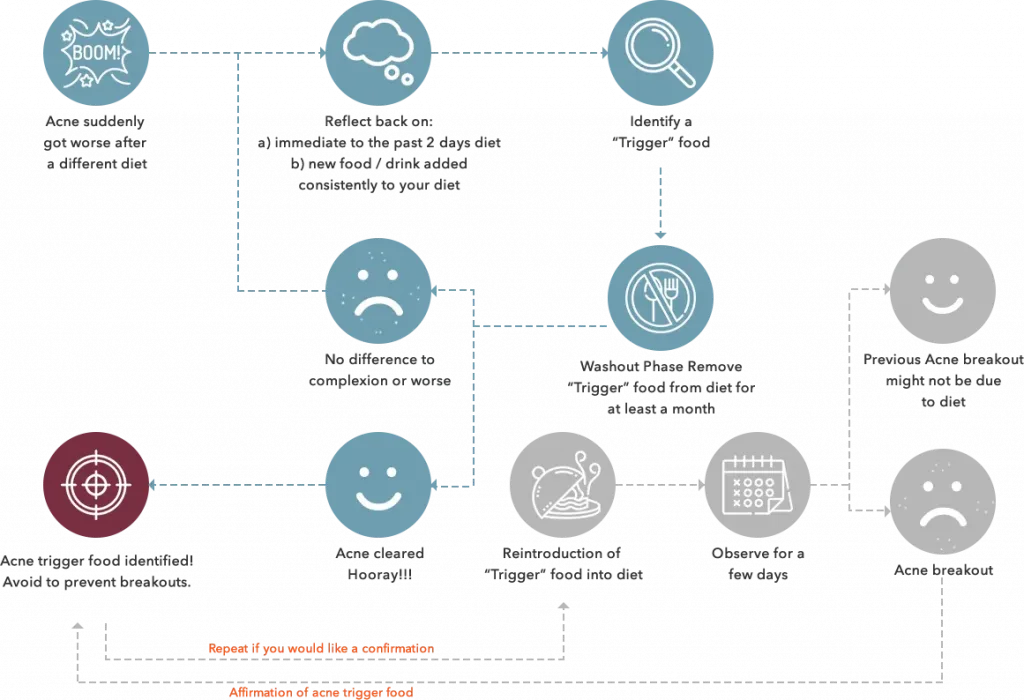
I did not quite believe diet would trigger acne outbreaks until I experienced it first-hand. When I was pregnant, I started taking soy milk during my second trimester. Over the 2 weeks of soy milk consumption, I realized that I started to have bumpy complexion and my acne started getting worse.
Initially thinking that the aggravation was a result of pregnancy and hormonal changes, I paid little attention. Yet, I realized that my entire forehead was covered in red pimples, as compared to my first trimester when I would only have random pimples popping up on my face.
I decided to put my suspicion to the test and stopped taking soy milk. I also used Skinlycious products to control my acne outbreak. True to my suspicions, my acne cleared up! Thereafter, throughout my pregnancy, I did not have any major outbreaks. From then on, I avoided soy milk and even soy products. Thereafter, I became more conscious about my outbreaks and food intake to see if there’s any co-relation. I also discovered that durians and spicy, greasy food are my acne triggers too.
Scientific Background
After years of research by scientists, there are still no conclusive studies that prove specific foods to be responsible for acne. Research results from studies conducted over the last 10 years demonstrate that diet does not cause acne, it may only influence or aggravate it. The main contributory factors are usually genetics, hormones and certain medications.
Elimination Methodology
However, I believe that everybody’s trigger is possibly different. I do not think that everyone’s acne can be affected by diet. Even so, every individual might possibly have different triggers. If you suspect that diet is causing your acne breakout, try our Elimination Methodology. Do this with only one “trigger” food at a time.
Acne Trigger Foods
Again, I must stress that these foods are not definite acne triggers for everybody. I have ranked the ‘Trigger’ Food list according to evidence level, with the top of the list having the highest evidence. The below list is not exhaustive. I have found my own acne triggers that are not listed in this list.
Slide 1
1) High Glycemic Load Foods!
A food’s glycemic load is a number that estimates how much the food will raise a person’s blood glucose level after eating it. High glycemic load food turns into blood sugar very quickly.
Some foods that contain high glycemic load are :
Potato (Think French fries, mashed potatoes)
White Rice
Couscous
Millet
Pasta made with white flour
White bread with butter/peanut butter/skim milk cheese
French Bread
Muffins
Sweet cakes
Beverages with high sugar content
Jelly Beans
Candy Bars
Refined breakfast cereal
For the full detailed list, you can refer to international table of glycemic index and and glycemic load values – an extensive list of 2,480 individual food items of different glycemic index and glycemic load values.
In a case control study done in Malaysia, subjects that had acne had significantly higher dietary glycemic loads compared to controls. Researchers from this study concluded that a high glycemic load diet and frequencies of milk and ice cream intake were positively associated with acne vulgaris.
Slide 2
2) Cow’s milk or Dairy Products!
Dairy products include:
Yogurt
Ice Cream
Cheese
Any other food that uses milk or diary products as ingredients
In two review studies of diet and acne, they found evidence that cow’s milk intake increased acne prevalence and severity. In 2005, in a retrospective study in 47,355 adult women, researchers’ inference was that acne was indeed positively associated with milk ingestion, especially skim milk.
In the above study example that I cited for high glycemic load diet, researchers also concluded increased milk intake would lead to worsening acne.
Slide 3
3) Omega-6 Fatty Acids Rich Foods
Some foods rich in omega-6 fatty acids are :
Vegetable oil such as safflower oil and corn oil
Mayonnaise and salad dressings
Deep fried food such as nuggets, fries, fried chicken, etc.
Cookies, candies, cakes, pastries and muffins
Dairy and eggs
Fatty red meat, such as pork and beef
In the review by Ferdowsian et.al., the researchers were not able to find published, large, well-controlled studies that examine the effect of fat or fatty acid intake on acne risk. However, a study has shown that omega-6 fatty acids are pro-inflammatory mediators have been associated with acne. Most high dietary fat diets are also high in glycemic load.
Slide 4
4) Chocolates
The review by Ferdowsian et. al., did not find any evidence to link chocolates to worsening acne. In 2011, Block et. al. reports her investigations where 10 men aged 18 to 35, who had previously been diagnosed with acne, ate as much pure chocolate as they wanted in one sitting, up to a maximum of three 4-ounce candy bars. Then they were told to follow their normal (chocolate-free) diet for a week. The candy bars were pure chocolate, made of 100% cocoa. At the start of the study, the men had an average of three pimples. By the fourth day, the figure had jumped to 13 and by the end of the week, they had an average of 18 pimples.
However, the above results are preliminary and it’s too small a sample size to conclusively point a finger at chocolates for worsening acne. Some researchers blame it on the milk that is found in milk chocolates or the high sugar content in some chocolates.
Slide 5
5) Soy
The evidence for soy is even more lacking. There are no big trials done investigating soy and acne. If you surf forums, you will notice that soy is pretty controversial as some claim that soy actually improves their acne condition while others claim that it worsens their acne condition.
Soy milk is made from processed soybeans, which can have estrogen-mimicking effects on the body. That could possibly be the reason for aggravating acne.
In the study by Law et. al., they found that in some cases, an intake of soy products was significantly linked to a lower incidence of acne. This association was noticed in subjects who were yang-predominant, according to traditional Chinese medicine. Yang is associated with heat and acute illness, according to the Alternative Medicine Foundation.
Acne Fighting Foods
Again, there is no hard evidence that the food listed below will clear your acne or help in acne prevention. However, I am combining a list of possible acne fighting foods based on scientific evidence. These are healthy foods that are good for your general health, thus, there is no harm in adding them to your diet.
Slide 1
1) Omega-3 Fatty Acids Rich Foods
Studies show that people who maintain a traditional diet high in omega-3 fatty acids have low rates of acne. Omega-3 fatty acids are known to reduce inflammation.
Your acne might look less red and angry after consuming these foods.
Fish such as salmon, tuna, trout, mackerel, sardines and herring
Nuts such as walnuts and butternuts
Seeds such as flax seeds, chia seeds, sunflower seeds
Oils such as canola oil, flaxseed oil, soybean oil
Slide 2
2) Selenium Rich Foods
Researchers found that acne patients have low levels of blood selenium. One other study found that the combination of selenium (400mcg) and vitamin E(20mg) led to improvements in acne patients.
Some foods rich in selenium are :
Brazil nuts
Sunflower seeds
Fish such as tuna, halibut, sardines, salmon
Shellfish such as oysters, clams, mussels, scallops
Red meat such as beef, lamb, pork, liver, kidney
Grains such as wheat germ, barley, brown rice, oats
Slide 3
3) Vitamin E Rich Foods
As described above, researchers found that acne conditions improved with the intake of Selenium and Vitamin E. Vitamin E food also help in reducing scarring.
Some foods rich in Vitamin E are :
Tofu
Leafy green vegetables such as spinach
Nuts
Sunflower seeds
Avocados
Shellfish such as shrimp, crayfish, oyster
Fish such as rainbow trout, swordfish, salmon
Broccoli
Slide 4
4) Vitamin A Rich Foods
Researchers have also found that lower levels of Vitamins A and E were found to be associated with severity of acne. Vitamin A helps regulate the skin cycle and is essential for great skin health. After all, Isotretinoin and Tretinoin – prescribed acne medication, closely resembles the structure of Vitamin A.
Some foods rich in Vitamin A are :
Sweet Potato
Carrot
Dark leafy green vegetable such as kale, spinach, pak choy.
Squash
Fruits such as cantaloupe melon, apricot, prune, peach, mango, papaya
Bell Peppers
Slide 5
5) Zinc Rich Foods
Study has shown that acne patients have lower levels of Zinc. They also found that patients with more severe acne had lower serum zinc levels compared to the milder cases. Top up your Zinc intake and you might see improvements in your acne.
Some foods rich in Zinc are :
Seafood such as oysters, crabs, lobsters
Red meat such as beef, lamb and pork
Wheat germ
Seeds such as pumpkin and squash seeds, sunflower seeds, chia seeds, flax seeds
Green leafy vegetables such as spinach, amaranth leaves
Nuts such as cashew nuts, pine nuts, pecans
Slide 6
6) Chromium Rich Foods
Very limited studies have been done on chromium and acne. There was an open label trial conducted and it showed that 400mcg of chromium improves acne.
This is very much still a hypothesis but there is some experimental evidence and clinical anecdotes on how an imbalance of gut bacteria can contribute to skin inflammation. Taking probiotics will help restore the healthy bacteria flora in the gut and possibly help in reducing acne.
Some foods rich in Probiotics are :
Live-cultured yogurt, especially homemade
Miso soup
Sauerkraut
Pickles
Tempeh
Kimchi
>
Conclusion
In summary, find your ‘trigger’ food that trigger your acne flares. Drink plenty of water and have a balanced healthy diet.
Making changes to your diet might help but using the right products is equally important! Use Skinlycious products to clear your acne and maintain acne-free skin.
Begin Your Clear Skin Journey
Our Starter Kits are the perfect way to try our products without committing to full-sized products! Other than helping to reduce acne, they also lighten post-acne marks, balancing and normalising acne-prone skin. Our Starter Kits even come with money back guarantee!
Essentials Starter Kit
All you need to get to get rid of your acne FAST! The basics needed to address the root causes of acne. See improvements in 7 days or your money back.
J. Burris, W. Rietkerk, K. Woolf Acne: The Role of Medical Nutrition Therapy Journal of the Academy of Nutrition and Dietetics, Volume 113/Issue 3 (March 2013)
Ferdowsian HR, Levin S Does diet really affect acne? Skin Therapy Lett. 2010 March;15(3):1-2, 5
Fiona S. Atkinson, RD, Kaye Foster-Powell, and Jennie C. Brand-Miller International tables of glycemic index and glycemic load values: 2008 Diabetes Care 2008 Dec; 31(12): 2281-2283.
Ismail NH, Manaf ZA, Azizan NZ High glycemic load diet, milk and ice cream consumption are related to acne vulgaris in Malaysian young adults: a case control study. BMC Dermatology. 2012 Aug 16;12:13
Adebamowa CA, Spielgelman D, Danby FW, Frazier AL, Willett WC, Holmes MD High school dietary dairy intake and teenage acne. Journal of the American Academy of Dermatology. 2005 Feb;52(2):207-14.
James MJ, Gibson RA, Cleland LG Dietary polyunsaturated fatty acids and inflammatory mediator production. American Journal Clinical Nutrition 71(1 Suppl):343S-8S (2000 Jan).
Law MP, Chuh AA, Molinari N, Lee A An investigation of the association between diet and occurrence of acne: a rational approach from a traditional Chinese medicine perspective. Clinical Experimental Dermatology 2010 Jan;35(1):31-5.
Alan C Logan Linoleic and linolenic acids and acne vulgaris. Br J Dermatol. 2008 Jan; 158(1):201-2.
Michaëlsson G Decreased concentration of selenium in whole blood and plasma in acne vulgaris. Acta Derm Venereol. 1990; 70(1):92.
El-Akawi Z, Abdel-Latif N, Abdul-Razzak K Does the plasma level of vitamins A and E affect acne condition? Clin Exp Dermatol. 2006 May; 31(3):430-4.
Majid RM, Nastaran SA, Nasrollah M, Maedeh S Correlation between the Severity and Type of Acne Lesions with Serum Zinc Levels in Patients with Acne Vulgaris Biomed Res Int. 2014; 2014: 474108.
McCarty M High-chromium yeast for acne? Med Hypotheses. 1984 Jul; 14(3):307-10.
Whitney P Bowe and Alan C Logan Acne vulgaris, probiotics and the gut-brain-skin axis – back to the future? Gut Pathog. 2011; 3: 1.






 0
0