What’s the Difference Between Mineral and Chemical Sunscreen?
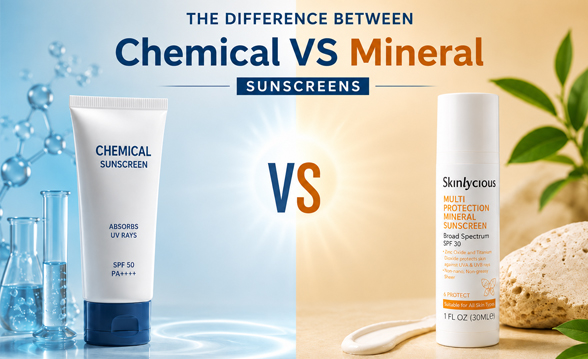
If you’ve been told to wear sunscreen every day (and you should be!), you might have noticed two types on the shelves: mineral and chemical. They both promise SPF protection, they both go on your face, and from the outside they look pretty similar.
But under the surface, they work in completely different ways — and for people with acne-prone or sensitive skin, that difference matters a lot more than most product labels let on.
Here’s what you need to know.
How They Work: The Fundamental Difference
Chemical Sunscreen — It Absorbs Into Your Skin
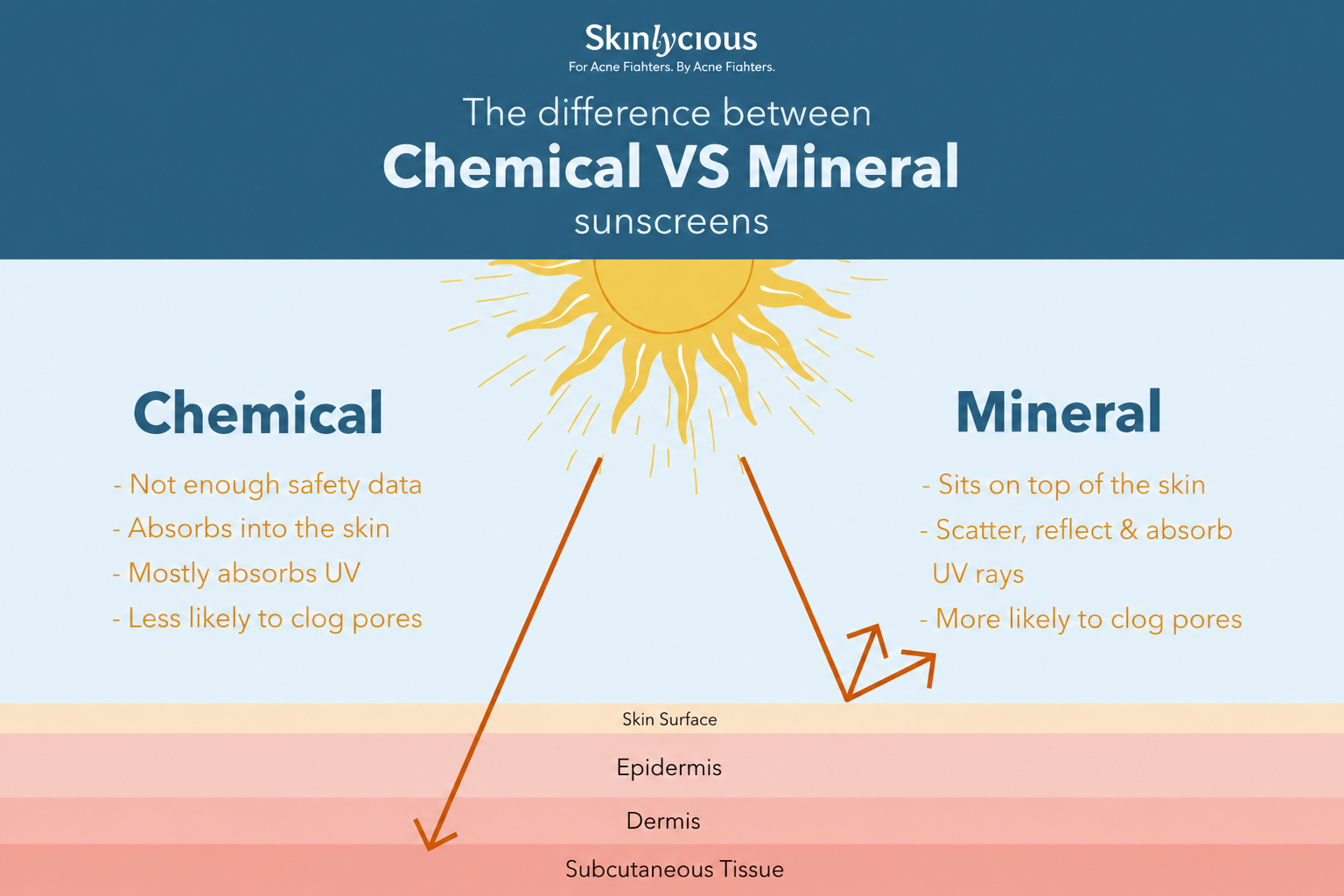
Chemical sunscreens work by absorbing into your skin, where they convert UV rays into heat and release that heat from your body. Common chemical filter ingredients include Oxybenzone, Avobenzone, Octinoxate, Homosalate, Octisalate, and Octocrylene.
The key word here is absorbs. The active ingredients don’t stay on the surface — they penetrate your skin layers to do their job.
Mineral Sunscreen — It Sits On Top of Your Skin
Mineral sunscreens (also called physical sunscreens) work differently. They contain Zinc Oxide, Titanium Dioxide, or both. Rather than absorbing into the skin, they sit on the surface and create a physical barrier that scatters, reflects, and absorbs UV rays before they can reach your skin.
Think of it like a mirror versus a sponge: mineral sunscreen reflects UV light away, while chemical sunscreen soaks it up and neutralises it.
The Safety Question: Why Chemical Sunscreen Is a Concern
This is the part that doesn’t get talked about enough.
In 2019 and 2020, researchers published studies showing that chemical sunscreen active ingredients are absorbed into the bloodstream — and can be detected in blood, urine, and even breast milk weeks after application stopped. This raised significant concerns, especially because some of these chemicals are classified as hormone disruptors.
Reference: A 2020 study published and covered by Medical Xpress found that chemical sunscreen ingredients enter the body systemically — not just the skin — after topical application. Read more here.
To be clear: we don’t yet have definitive proof that these chemicals are causing measurable harm at typical usage levels. But here’s the problem — we also don’t have enough safety data to confirm they’re safe. When it comes to ingredients that could disrupt hormones and are absorbed into your bloodstream, that absence of evidence is itself concerning.
This is especially relevant for:
Jasmine’s view: “Without enough safety data on chemical screens, it is safer to use a mineral sunscreen. The precautionary principle applies here — if we’re unsure, why take the risk when a safer option exists?”
The Problem With Mineral Sunscreen: Clogged Pores
So if mineral sunscreen is safer, why doesn’t everyone use it? There’s a real catch.
Because mineral sunscreen sits on top of the skin rather than absorbing into it, it’s much more likely to clog pores. Zinc Oxide in particular — one of the most effective UV-blocking ingredients — is notorious for being pore-clogging and heavy on the skin. For people who already deal with breakouts, this is a serious problem.
Most mineral sunscreens on the market were formulated without acne-prone skin in mind. The result: people with breakout-prone skin try a mineral SPF, break out from it, and conclude that “sunscreen doesn’t work for my skin” — when really, it was the wrong formula for their skin type.
Jasmine’s One-Year Formulation Journey
This was exactly the challenge Jasmine faced. As someone with acne-prone, oily, and sensitive skin, she knew mineral sunscreen was the right choice from a safety standpoint. But every formula she tried either broke her out or left her looking ghostly white (the classic “white cast” problem with zinc oxide).
She spent over a year testing and refining, working through different zinc oxide particle sizes, emollient combinations, and base formulas — testing on herself and a group of real acne-prone skin customers — before she found a formula that worked.
The result is the Skinlycious Multi-Protection Mineral Sunscreen: a mineral SPF that doesn’t cause breakouts, doesn’t leave a white cast, and is gentle enough for sensitive, reactive skin.
What Does This Mean for Acne-Prone Skin?
If you have acne-prone skin, you’re navigating two competing concerns:
The answer isn’t to avoid sunscreen — it’s to find a mineral sunscreen that’s been specifically formulated to be non-comedogenic (pore-friendly) for acne-prone skin. That’s exactly what the Skinlycious Multi-Protection Mineral Sunscreen was designed to be.
One More Thing: Mineral Sunscreen Must Be Properly Removed
Because mineral sunscreen sits on the surface of your skin, it doesn’t just rinse off with water — and a regular cleanser often won’t fully lift it either. If left on overnight, that residue can mix with sebum and dead skin cells and contribute to the very congestion you’re trying to avoid.
This is why double cleansing in the evening matters — starting with a first cleanser designed to break down sunscreen (like Skinlycious Soothing Cleansing Gel), followed by your regular daily cleanser (like Calming Cleanser).
Evening routine tip: Soothing Cleansing Gel → Calming Cleanser. Two steps, clean skin, no residue.
A Note from Jasmine
I switched to mineral sunscreen before I formulated my own. It wasn’t easy — most mineral SPFs either broke me out or made my face look patchy and white. I went through formula after formula until I found something that worked for my skin and the customers I was testing with.
It took over a year. But I couldn’t in good conscience recommend a chemical sunscreen to someone dealing with acne, knowing what we know about hormone disruption — especially when so many of the customers coming to me were teenagers and young adults whose skin was already hormonally reactive.
If sunscreen is something you wear every day — and I hope it is — it’s worth choosing one that’s not only effective, but one you feel genuinely confident about.
Try the Skinlycious Mineral Sunscreen
Formulated over a year. Tested on real acne-prone skin. No white cast, no breakouts.
✦ Mineral Sunscreen

Multi Protection Mineral Sunscreen Broad Spectrum SPF 30
Protects against UVA/UVB rays. Anti-pollution. With Antioxidant.
✦ A soothing gel cleanser for SPF Removal

Soothing Cleansing Gel
Removes makeup without disturbing skin balance
About the Author

Jasmine Kang
Founder of Skinlycious - a skincare brand built specially for acne-prone, oily-prone, and sensitive skin. A mompreneur with a Biomedical Science degree and a Diploma in Organic Skincare Formulation, Jasmine spent 14 years fighting acne and another 10 years refining her formulas alongside fellow acne fighters to perfect the Skinlycious range.
Her greatest joy? Helping people get clear, smooth and glowing skin and regain confidence through her Match+Balance System™.